

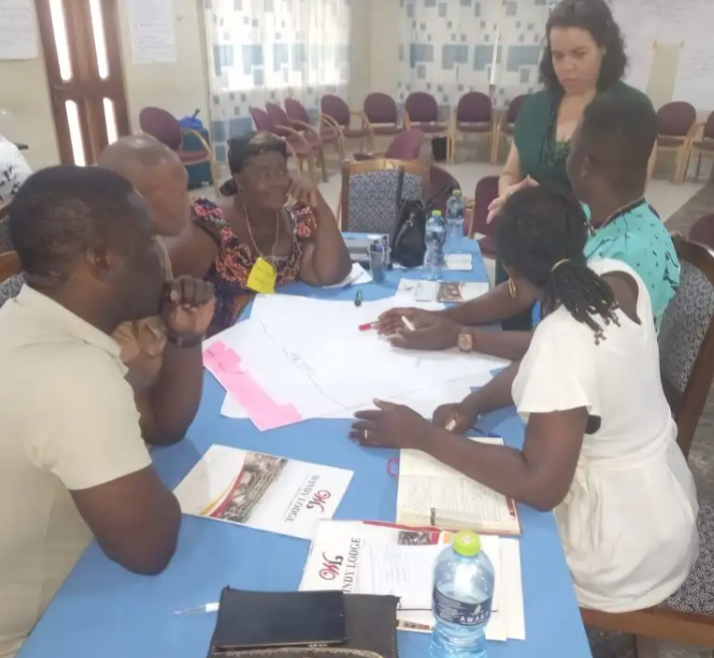
Thirty fishers and industry stakeholders from Ghana’s four coastal regions have participated in training under the inaugural Small-Scale Fisheries Academy (SSF Academy) aimed at fostering dialogue and co-management within their fishing communities.
The two-day workshop convened chief fishermen, canoe owners, fish processors, and officials from the Fisheries Commission to enhance their facilitation skills for community engagement and inclusive fisheries management.
Organized by the SSF Academy and its partners, the academy serves as a platform for fishers and other industry participants to address challenges facing the sector and to develop community-driven solutions.
Madam Maua Fernanda Anaes, the lead facilitator, along with Mr. Anthony Acheampong, the co-facilitator, guided participants in establishing local co-management structures, facilitating dialogue, and promoting inclusive decision-making.
In his opening remarks, Prof. Benjamin Betey Campion, Executive Director of the Fisheries Commission, urged stakeholders to move beyond merely addressing the symptoms of challenges in the fisheries sector and to focus on identifying and eliminating their root causes.
He emphasized that tackling the underlying issues would ensure that limited investments yield sustainable results for fishing communities.
Prof. Campion characterized the training as timely, asserting that effective facilitation skills would empower Fisheries Commission officers and community leaders to support co-management initiatives at the local level.
He encouraged participants to return to their communities and advocate for dialogues aimed at improving sanitation at landing beaches, restoring fish stocks, and enhancing livelihoods.
Regarding the rationale for the academy, Nana Kweigya, Partnership Manager for Blue Ventures-Ghana and National Coordinator of the SSF Academy, stated that the initiative aims to address challenges such as illegal fishing, pollution, and unsanitary conditions through community involvement.
He noted that the academy was established through a partnership involving Blue Ventures, Mundus Maris, and the Canoe and Fishing Gear Owners Association of Ghana (CaFGOAG) to complement government efforts in restoring fisheries resources and safeguarding livelihoods.
In this context, he explained that the academy utilizes inclusive adult learning methods and promotes peer learning, ensuring that men, women, youth, and other stakeholders in the fisheries value chain collaboratively identify challenges and develop practical local solutions.
Nana Kweigya highlighted that the legal framework for fisheries co-management provides an opportunity for fishing communities to engage in decision-making, underscoring that effective dialogue at the community level is crucial to achieving these objectives.
Credit to Access Agric