


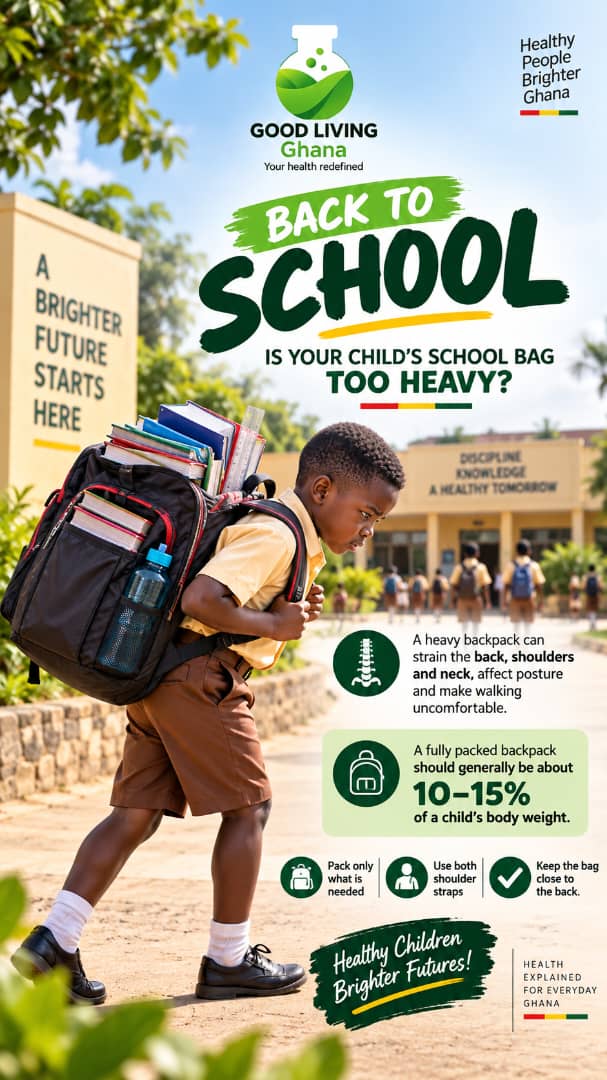
School has reopened. For many children, the morning routine is the same: uniform on, shoes polished, lunch packed, and school bag filled with books.
But there is something many parents may not be paying attention to:
How heavy is that school bag?
Some children carry several textbooks, exercise books, notebooks, stationery, and water bottles on their backs for hours every day.
A school bag that is consistently too heavy can put unnecessary strain on a child’s developing body.
WHAT CAN A VERY HEAVY SCHOOL BAG DO?
1. Back and shoulder pain
Excessive weight places extra stress on the muscles of the back, shoulders and neck. A child may start complaining of backache or shoulder pain, especially after school.
2. Neck and muscle strain
When a bag is too heavy, children often lean forward or tighten their neck and shoulder muscles to compensate for the weight. Over time, this causes discomfort and muscle fatigue.
3. Poor posture
A child with a very heavy bag may bend forward, hunch the shoulders, or change the way they walk to balance the load. If this happens every day, it encourages poor posture habits.
4. Difficulty walking comfortably
An overloaded backpack can affect balance and make walking, climbing stairs, or moving around school more uncomfortable. This is especially important for younger children.
5. Pressure on the shoulders
Thin or poorly adjusted straps can dig into the shoulders and cause pain. A bag hanging too low also makes the child lean forward.
SO, HOW HEAVY SHOULD A SCHOOL BAG BE?
A commonly recommended guideline is that a child’s fully packed backpack should be no more than 10-15% of the child’s body weight.
For example:
– A child weighing 30kg should ideally carry 3 – 4.5kg or less
– A child weighing 40kg should carry 4 – 6kg or less
The exact safe load varies depending on the child, the backpack design, and how long it is carried.
WHAT CAN PARENTS DO?
Before your child leaves for school each morning:
✓ Check the bag: Remove unnecessary books and items. Carry only what is needed for that day.
✓ Use both straps: Always use both shoulder straps, not one shoulder.
✓ Adjust properly: The backpack should sit comfortably close to the back, not hanging low near the waist.
✓ Choose wisely: Choose a backpack with wide, padded straps, a padded back, and good support.
✓ Talk to the school: Encourage lockers, classroom storage, or timetabling that reduces daily load where practical.
And don’t ignore repeated complaints.
If your child regularly complains of back pain, neck pain, shoulder pain, numbness or tingling, don’t assume they are being dramatic. Have the child assessed by a qualified healthcare professional.
A SIMPLE BACK-TO-SCHOOL REMINDER:
Your child’s school bag is supposed to carry their books – not carry unnecessary weight at the expense of their comfort.
Before school each morning, don’t just ask:
_”Do you have all your books?”_
Also ask:
_”Is your bag too heavy?”_
GOOD LIVING GHANA
_Health explained for everyday Ghana._