

ACCRA, Ghana – Ghana’s cashew industry is under renewed pressure following a sharp decline in farm-gate prices in 2025 and continued dependence on raw nut exports, despite producing hundreds of thousands of tonnes annually.
A new independent study warns that weak local processing is costing the country jobs, revenue and market stability.
The report, _“Ghana Cashew Processing Sector and Roadmap for a Supportive Cashew Public Policy”_, was conducted by agricultural economics consultancy Nitidae with support from the Association of Cashew Processors of Ghana [ACPG], GIZ and the European Union Delegation to Ghana.
Less Than 6% of Cashew Processed Locally
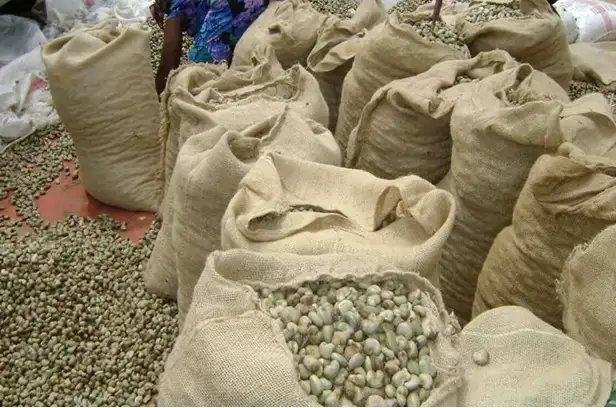
Ghana is estimated to produce 262,000 metric tonnes of raw cashew nuts annually. Yet in 2025, only about 15,000 metric tonnes were processed locally — less than 6% of total production.
More than 94% of locally produced raw cashew nuts were exported or traded without being processed domestically, the study found.
The ACPG says this means Ghana is exporting the very jobs and value it claims to want.
“Every tonne we export raw is a factory job, a tax cedi and a unit of foreign exchange we are choosing to send to Vietnam and India instead of keeping in Ghana,” said ACPG President, Mr. Antonio Manuel Caramelo Raposo.
2025 Price Volatility Hits Farmers Hard
The study highlighted severe price swings that have left farmers vulnerable.
Farm-gate prices started at about GH¢16 per kg in January 2025, rose to GH¢20 per kg in February, then crashed to around GH¢7 per kg by May.
Similar volatility was recorded in 2023, when prices fell from GH¢11 per kg in March to GH¢2.80 per kg in May.
“Without a strong local processing industry to provide an alternative and more structured market, farmers remain highly exposed to changes in international demand,” the report noted.
Ghana Exports More Than It Produces
In a major paradox, Ghana exported approximately 444,000 tonnes of raw cashew nuts in 2025, mainly to Vietnam and India — far more than the 262,000 tonnes it produced.
Nitidae attributes the difference to an estimated 165,000 tonnes of raw cashews imported informally from Côte d’Ivoire, Mali and Burkina Faso and re-exported through Tema Port.
The study says Ghana’s liberal raw export regime has turned the country into a transit hub for raw nuts, while doing little to build domestic processing capacity.
Jobs and Revenue Lost
According to the report, a modern 20,000-tonne processing factory could employ at least 120 full-time workers and 500 daily workers. With current production, Ghana could potentially support more than 10 such factories.
Instead, most processing and value addition happens abroad.
“Most of the added value is generated outside of Ghana,” the study observed.
High Costs Discourage Investment
Setting up a 20,000-tonne factory in Ghana costs an estimated US$9.2 million, compared to US$5.3 million in Vietnam. Ghanaian processors also face high electricity costs, expensive machinery, limited industrial support, and interest rates around 20%, compared to 9% in Vietnam.
ACPG Calls for Urgent Government Action
The ACPG is urging government to treat cashew as an urgent priority under the 24-Hour Economy and Accelerated Export Development agenda.
The association noted that President John Dramani Mahama and Senior Presidential Advisor Augustus Goosie Tanoh have both warned against exporting raw materials and importing finished goods.
“Cashew is not a hypothetical case of the problem the President and Mr Tanoh have been describing all year; it is that problem, with a name and a number attached,” the ACPG stated.
Key Recommendations
The Nitidae report cautioned against a blanket ban on raw exports but proposed:
– A two-component export levy with fixed and floating rates tied to international prices
– A Cashew Development Fund* to support farmers and processors
– Tax and VAT exemptions on inputs for processors
– Improved access to working capital and dedicated agro-industrial parks in Bono and Bono East
It also noted opportunities in by-products like Cashew Nut Shell Liquid, biofuel and biochar, which countries like Vietnam and India already monetize.
Stakeholders say the future of Ghana’s cashew sector depends not just on growing production, but on processing more of what is produced locally.
#Cashew #GhanaAgriculture #ACPG #AgroProcessing #BonoRegion #24HourEconomy #GhanaEconomy #Farmers #TheDailyNewsflash