

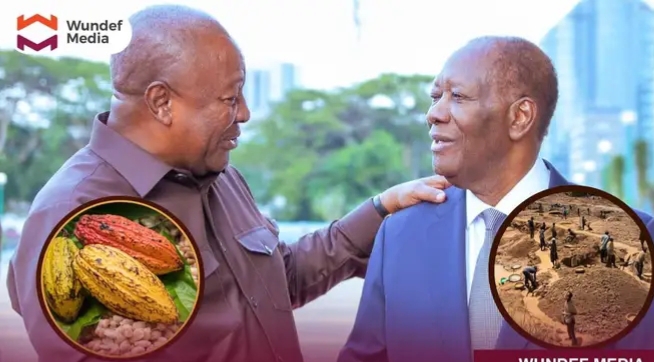
President John Dramani Mahama of Ghana and Ivorian President Alassane Ouattara have resolved to intensify their efforts against illegal mining and environmental degradation, identifying these issues as significant threats to the future of the cocoa industry in West Africa.
This commitment was articulated during the Côte d’Ivoire-Ghana High-Level Summit on the Future of the Cocoa Economy held in Abidjan, where the two leaders adopted a Joint Declaration aimed at safeguarding cocoa production, improving farmer livelihoods, and enhancing cooperation between the world’s two largest cocoa-producing nations.
The summit occurs at a pivotal moment for the cocoa sector, as both Ghana and Côte d’Ivoire face challenges such as declining productivity, climate-related issues, crop diseases, and the increasing threat of illegal mining activities that continue to devastate farmlands and pollute water bodies.
Illegal Mining as a Major Threat to Cocoa Production
During their deliberations, Presidents Mahama and Ouattara expressed serious concern over the growing impact of illegal mining on agricultural lands, forests, rivers, and lakes that are vital for cocoa production.
In Ghana, illegal mining—commonly referred to as galamsey—has been increasingly blamed for the destruction of cocoa farms, contamination of water sources, and loss of fertile agricultural land. Similar environmental concerns have also arisen in parts of Côte d’Ivoire.
The two leaders concurred that unless urgent measures are implemented, environmental degradation could significantly jeopardize efforts to sustain cocoa production and improve the livelihoods of millions of farmers who rely on the crop.
As part of the agreement, both countries committed to developing a coordinated strategy to mitigate illegal mining activities, restore degraded lands, and rehabilitate polluted water bodies shared across their borders.
Joint Clean-Up and Environmental Restoration Program
The leaders also agreed to initiate comprehensive clean-up operations targeting rivers, lakes, and other water sources affected by illegal mining and environmental pollution.
Environmental sustainability was a focal point during the summit, with both countries acknowledging that climate change and environmental degradation increasingly threaten agricultural productivity across the region.
The proposed interventions are expected to complement broader efforts to enhance environmental governance and protect critical ecosystems that support cocoa cultivation.
Safeguarding a Sector That Sustains Millions of Livelihoods
Ghana and Côte d’Ivoire together account for approximately 60 percent of global cocoa production, making them central players in the international cocoa market. The two countries have consistently emphasized the need for stronger cooperation to protect farmers and ensure the long-term sustainability of the industry.
Officials at the summit stressed that environmental protection must now become a core component of cocoa sector reforms.
The renewed collaboration is part of the broader Côte d’Ivoire-Ghana Cocoa Initiative (CIGCI), which seeks to strengthen cooperation on pricing, sustainability, traceability, farmer welfare, and sector resilience.
Climate Change and Cocoa Diseases Also on the Agenda
Beyond illegal mining, the two leaders discussed the growing threat posed by climate change and crop diseases to cocoa production.
They pledged to strengthen cooperation between their respective research institutions to combat Cocoa Swollen Shoot Virus Disease (CSSVD), one of the most destructive diseases affecting cocoa farms in West Africa.
The leaders also committed to expanding scientific research and innovation to help farmers adapt to changing weather patterns, declining yields, and emerging agricultural threats. These issues have become increasingly important as both countries seek to revive cocoa production and enhance sector sustainability.
Building a Sustainable Future for Cocoa
The environmental commitments made in Abidjan align with broader efforts by both governments to transform the cocoa sector into a more resilient and profitable industry.
Recent discussions under the Côte d’Ivoire-Ghana Cocoa Initiative have focused on improving farmer incomes, harmonizing cocoa pricing, strengthening sustainability standards, and promoting local processing to ensure producing countries capture more value from the global cocoa-chocolate industry.
For Presidents Mahama and Ouattara, protecting the environment is now inseparable from securing the future of cocoa.
Their joint initiative against illegal mining reflects a growing recognition that safeguarding farmlands, forests, and water resources will be essential if Africa’s two cocoa giants are to ensure the long-term viability of one of their most significant economic sectors.