

Accra – The Government of Ghana has reaffirmed its commitment to transform the country’s oil palm industry, announcing plans to support the establishment of 100,000 hectares of new oil palm plantations under the National Integrated Palm Oil Development Policy 2026-2032.
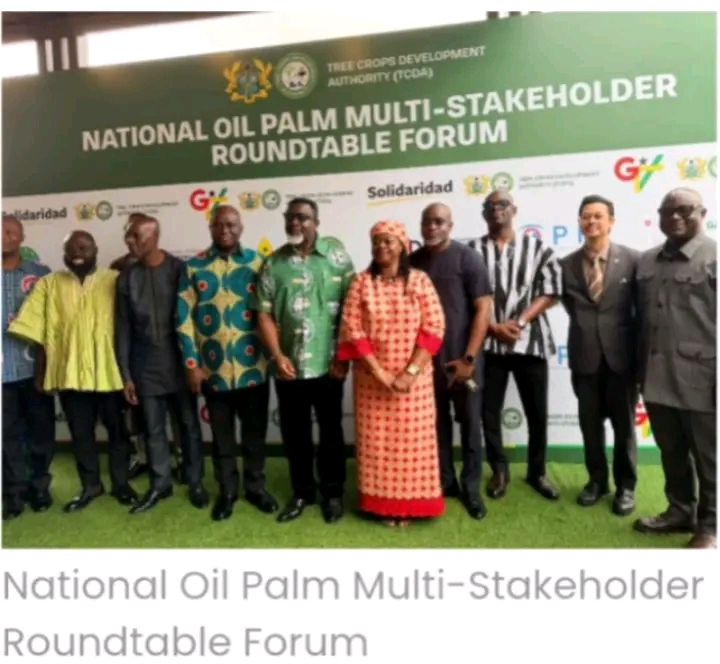
The announcement was made by the Minister for Food and Agriculture at the National Oil Palm Multistakeholder Roundtable Forum held in Accra on Wednesday under the theme _“From Policy to Practice: The Role of TCDA in Resetting Ghana’s Oil Palm Industry.”_
The Big Goal: Jobs, Self-Sufficiency and Exports
The 100,000-hectare expansion was captured in the 2026 Budget and Economic Policy Statement.
According to the Ministry, the programme is expected to:
– Create 725,000 direct and indirect jobs
– Make Ghana self-sufficient in palm oil
– Establish Ghana as the palm oil hub of West Africa
– Cut the country’s $200 million annual palm oil import bill
“This expansion is part of a broader strategy to move the oil palm industry from policy commitments to measurable results,” the Minister said.
How It Will Work
The programme will be led by the Tree Crops Development Authority (TCDA) in partnership with the CSIR-Oil Palm Research Institute (CSIR-OPRI) and the private sector.
Key components include:
– Smallholders Prioritized: Farmers will receive improved hybrid seedlings, subsidized fertilizer, guaranteed off-take arrangements, training, and access to financing.
– *Seedlings: CSIR-OPRI currently has the capacity to produce 1 million hybrid seedlings per year. A total of 15 million seedlings will be needed for the 100,000 hectares.
– Land: 16,000 hectares of land have already been assessed. 10,780 hectares in the Western Region alone have been identified as suitable. Mapping is ongoing in the Central, Eastern, and Volta Regions.
The forum brought together government officials, TCDA, farmers, processors, investors, research institutions, development partners, traditional authorities and other actors across the oil palm value chain.
Why Oil Palm Now?
Officials say the push for oil palm is part of efforts to diversify Ghana’s economy beyond its traditional reliance on cocoa, gold, and timber.
The key objectives outlined by CSIR-OPRI and government are:
1. Diversify revenue and create new economic pillars
2. Reduce reliance on cocoa, gold and timber exports
3. Integrate rural communities into commercial agriculture
4. Add value locally instead of exporting crude palm oil
Oil palm is one of 6 “anchor tree crops” identified by government alongside cashew, coconut, rubber, mango, and shea. Each of the 6 crops is projected to generate up to $2 billion annually for the economy.
Industry Reaction
Stakeholders at the roundtable welcomed the policy, noting that guaranteed markets and support for smallholders will be critical to the success of the 100,000-hectare target.
With land mapping ongoing and seedling production being scaled up, government says implementation of the National Integrated Palm Oil Development Policy will begin in phases across the identified regions.
_By Daily Newsflash_
#OilPalm #TCDA #CSIROPRI #Agriculture #FoodAndAgriculture #GhanaEconomy #Jobs #TreeCrops #SelfSufficiency #DailyNewsflash