

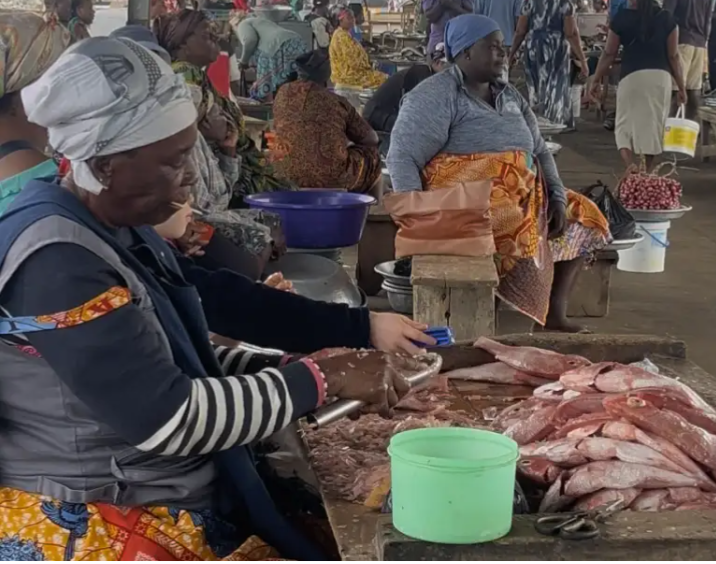
It’s another busy Friday afternoon at *Makola Market*.
*Gifty Gyan*, a civil servant and mother of five, is making a quick stop before the weekend.
She picks up smoked mackerel and a piece of tuna. Smells them. Haggles a bit with the vendor. Drops them in her tote bag and moves on.
But Gifty doesn’t ask where the fish was caught.
She doesn’t ask who caught it.
She doesn’t ask if the vessel that brought it in was operating legally.
She’s never had to.
“All I want is freshly smoked fish at a moderate price,” she tells the _Ghana News Agency_.
And Gifty isn’t alone.
She represents millions of Ghanaians who buy fish every week without thinking about the journey it took to get to their plate — how it was harvested, handled, or whether it was caught sustainably.
That may soon change.
*Ghana: A Nation That Lives On Fish*
Fish isn’t a luxury here. It’s survival.
Six out of every 10 Ghanaian households depend on fish as their main source of animal protein. From grilled mackerel to tuna in stew, from barracuda in soup to sardinella for “Fante Fante,” fish is on our tables daily.
But according to *Papa Yaw Atobrah*, a fisheries expert with 40+ years in the sector, most of us know nothing about what happens between the net and the market.
“Who is allowed to fish in our waters? How much are they catching? Are they following the rules? Will there still be fish for the next generation?” he asks.
“It’s about accountability. Policy makers hold these resources in trust for us. We need to know the state of fish stocks and the vessels exploiting them.”
That’s the gap the *Fisheries Transparency Initiative, FiTI*, is trying to close.
*Ghana’s Promise: Open The Books*
In 2024, Ghana officially committed to FiTI — a global initiative pushing for transparency and sustainability in marine fisheries.
Then-Minister *Hawa Koomson* presented the endorsement in Rome. Current Minister *Emelia Arthur* later signed off and set up a *National Multi-Stakeholder Group, NMSG*, to drive it.
An assessment found that a lot of fisheries data already exists in government institutions. The problem? It’s scattered and locked away from the public.
*Dr. Godfred Ameyaw Asiedu*, FiTI Regional Coordinator for Anglophone Africa, says that’s the point.
“If citizens have access to the data, they can demand accountability,” he told GNA.
Under FiTI, governments must publish information on fishing licenses, vessels in our waters, reported catches, and actions taken against illegal fishing.
In June, during the _Our Oceans Conference_ in Kenya, the NMSG helped launch an *online Fisheries Information System* so Ghanaians and the world can access key data on Ghana’s marine fisheries.
But there’s a catch: funding.
“We could have done more if we had adequate funding,” Dr. Ameyaw admits.
*Why This Matters To You At The Market*
Illegal, Unreported and Unregulated fishing — *IUU* — is costing Ghana and other developing countries billions.
*Ernest Arthur*, a fisherman in Takoradi, breaks it down:
“Industrial vessels fishing where they shouldn’t. Small nets catching baby fish before they can reproduce. Using lights at night to scoop up everything. Falsifying records. All of it strips the ocean faster than it can recover.”
And that fish? It ends up on the same market tables as legally caught fish.
The result: higher prices, smaller fish, and empty spaces where certain species used to be.
*Dr. Andrews Agyekumhene*, Senior Lecturer at UG’s Department of Marine and Fisheries Sciences, says we’re already feeling it.
“Consumers feel the effects every time they go to market. They just don’t connect the dots.”
Take sardinella. Once cheap and everywhere. Today, scarce and expensive.
The Environmental Justice Foundation says for every 10 sardinella we had 30 years ago, only 2 remain. FAO warns the fishery is close to collapse.
“What was food for everyone is becoming food for those who can afford it,” Dr. Agyekumhene says.
“FiTI isn’t about making fish expensive. It’s about making sure there’s still fish to buy.”
*The Information We Still Can’t See*
FiTI requires that fisheries data be published in ways ordinary people can understand — not buried in government databases.
*Philip Prah* of _Friends of the Nation_ and NMSG member says we’re not there yet.
A full public vessel registry isn’t available. That means a market woman, journalist, or parent can’t easily check if the company supplying their fish has a valid license or a record of violations.
“Even when the data is available, government must help NMSG create awareness,” he adds. He suggests using revenue from vessel fines to fund NMSG work.
*What Seychelles Got Right*
Seychelles is the first country to achieve full FiTI compliance.
*Nathaniel Morel* of Seychelles’ Blue Economy Department says it worked because they made information public and simple.
“Reports, technical info, activities — we broke it down and put it on social media. Short videos. Reels answering: how many people work in fisheries? How big should fish be? How many vessels do we have?”
Government funding helped their NMSG reach fishermen, processors, and consumers.
*Ghana’s Next Step*
Minister *Emelia Arthur* says government recognizes transparency is key and will allocate part of the Ministry’s budget to support NMSG. She also says Ghana is working with Norway to revive the expired _Fish Development Fund_.
But Dr. Agyekumhene worries there’s no clear timeline.
Yes, stricter rules could mean less fish in markets short-term and higher prices. But experts say we’re already paying the price of inaction.
*Back At Makola*
Gifty wraps her mackerel in newspaper and heads home.
When asked if she’d want to know more about where her fish comes from, she pauses.
“If it means my children will still have fish to eat in ten years, then yes,” she says.
“Tell me what I need to know.”
And that, says Dr. Agyekumhene, is exactly why Ghana signed onto FiTI.
Transparency isn’t just about data. It’s about giving people like Gifty the power to understand and protect the resource that feeds families, supports livelihoods, and secures our future.
The fish on our plates — and the generations after us — are waiting.
_Article by Dr. Georgia_
_#DailyNewsflash_